Boise County Glass Recycling Concerns
Open Letter to Idaho World Editor, Boise County Commissioners, Sheriff, and Waste Management
We were sorry to read in The Idaho World that Boise County is embarking on a public-private partnership glass recycling project with Republic Services (Idaho City), Miller Enterprises (Horseshoe Bend), and Environmental Abrasives (Boise) that is not needed and likely will add to county expense. Similar programs have proven expensive in more populous blue states and cities (which often subsidize recycling with deposit fees).
We would rather not see Boise County government expand in this way, even if “citizens want it.” Adding more services and creating taxpayer dependency on another program is not good governance. Instead, let’s focus on core services including road maintenance, law enforcement, courts, emergency management, litter cleanup (with help from Community Justice, citizens, schools, and other volunteer groups), and good overall fiscal management.
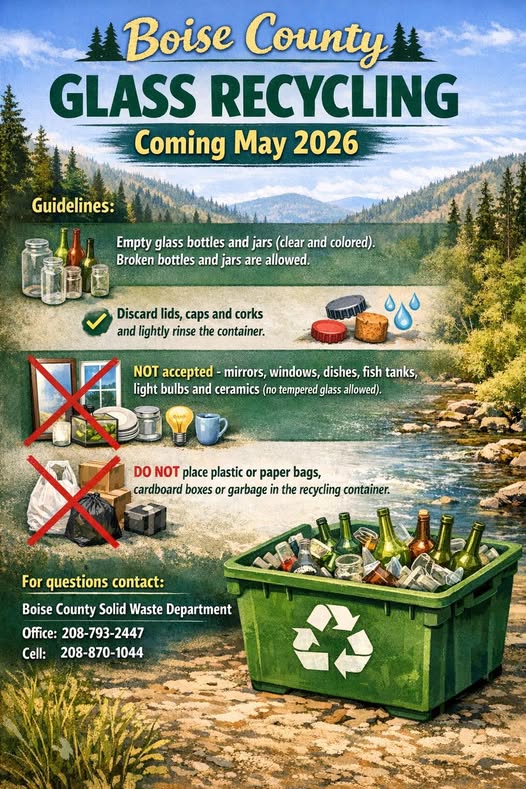
Boise County pilot (May-July 2026, drop-off at 3 transfer stations, not Lowman):
- Sends dedicated containers to Environmental Abrasives in Boise for processing into sandblasting abrasives (not new glass bottles).
- Accepts clean empty bottles/jars (clear/colored, broken OK).
- Excludes lids, non-container glass, ceramics, etc.
- No specific costs disclosed.
- No additional landfill fees to citizens.
- Continuation depends on participation, transport/recycling costs not exceeding landfill fees.
Potential costs:
- Collection/roll-off containers, transport to Boise, processing.
- US data shows glass recycling often costs $10–$40+/ton to processors (plus collection/transport).
- Materials Recovery Facility (MRF) contamination adds expense.
- Landfill tipping in Ada County ~$33/ton (recent).
- Glass is heavy, raising haul costs.
- Many programs run at a net loss vs. landfilling unless markets pay or avoid high landfill fees.
- Local precedent (Boise) shows savings in some cases by diverting from landfill, but depends on volume and exact fees.
- Pilot program aims for cost parity or better.
Comparison to other blue states/cities (CA, OR, WA, e.g., Seattle, Portland, San Francisco):
- Blue states/cities often have higher glass recycling rates (OR ~51%, some bottle bills/deposits help).
- Many use curbside or drop-off but face similar issues: high collection/processing costs, contamination in single-stream, low/negative cullet* values leading some to drop glass or switch to specialized collection.
- States with deposit systems achieve better rates (e.g., ME 76%); without deposits, rates lag and costs rise.
- Rural/low-volume areas like Boise County struggle more than dense urban ones due to transport economics.
- Many municipalities nationwide have scaled back glass in curbside due to economics.
* Cullet is “recycled broken or waste glass used in glass-making.”
Pros:
- Conserves raw materials (sand, soda ash, limestone).
- Diverts from landfills (glass doesn’t decompose).
Cons:
- High collection/transport costs (heavy material).
- Contamination reduces value.
- Sorting is labor-intensive.
- Limited markets for mixed/color-sorted glass; often cheaper to landfill in low-fee areas.
- Low participation in drop-off can make program uneconomic.
Please, commissioners, let’s scrap this idea before it proceeds further and focus on core services only.
- Recycling program description (Sheriff Facebook page): https://tinyurl.com/5ba7ycxx
- Recycling costs and rural vs. blue city/state comparisons https://tinyurl.com/4jtvm2uh and https://tinyurl.com/3nu3pymd
Updates 05/10/26
Where Does Our Trash Go?
On 05/09/26, we learned from a County Commissioner that Boise County takes its material from Boise County transfer stations to Clay Peak Landfill in Payette County. This information changes our assumptions about transport time/distance, as shown below (per Google Maps). Biggest impact is for the Idaho City Transfer Site, which is much closer to Environmental Abrasives than to the Clay Peak Landfill.
Current Destination: Payette Landfill (Payette): 2560 Hwy 52, Payette, ID
Glass Recycling Destination: Environmental Abrasives (EA): 4301 S Federal Way, Boise, ID
Idaho City Transfer Site: 900 Centerville Road, Idaho City, ID
- To Payette: ~2 hr
- To EA: ~1 hr
Garden Valley Transfer Site: 466 Middle Fork Road, Garden Valley, ID
- To Payette: ~1.5 hr
- To EA: Just under 1.5 hr
Horseshoe Bend Transfer Station: 203 Old Emmett Road, Horseshoe Bend, ID
- To Payette: ~1 hr
- To EA: ~52 min
Why Does Boise County Solid Waste Think Glass Recycling is Worth a Try?
We received a prompt and thoughtful reply on May 6, 2026, from Boise County Solid Waste Management Superintendent Kerri Pattee-Krosch regarding our letter. Her response is copied below.
Good morning,
I understand that you are concerned that the glass recycling pilot program will add to county expense. That is not the intent, nor would we move forward with the program if it proves to add additional expense to the Solid Waste Department.
We decided on a three month pilot to see if the program would be feasible. There are many factors that could impact pricing, with the main factor being participation level. After analyzing the costs we were quoted, we felt that the initial costs to start the program were low enough to warrant a pilot period. I am attaching the cost listing for the pilot program. Environmental Abrasives will take the glass at no cost and they would like more glass, if they are able to get it, besides what the programs in the valley are providing them currently.
For our most recent completed Fiscal Year 2025, we paid an average of $125.68 per ton to take our solid waste to the landfill. Idaho City was an average of $133.89 per ton and Horseshoe Bend/Garden Valley was an average of $123.14. This includes container rentals, hauling costs and the tipping fees we pay at the landfill. Bear in mind that the cost per ton has increased for the current fiscal year.
I do not want to make any claims that are not backed up with some sort of data. I will be providing updates to the County Commissioners and we will make a cost analysis and feasibility determination after the 3 month pilot.
If you have any additional questions or concerns that I have not addressed, please feel free to reach out to me.
Thank you,
Kerri Krosch
Boise County Solid Waste Superintendent
Mailing: PO Box 309
Physical Address: 201/203 Old Emmett Road
Horseshoe Bend, Idaho 83629
Office: 208-793-2447
Cell: 208-870-1044
Email: [email protected]
Attachment: GLASS RECYCLING PILOT PROGRAM COSTS (PDF)